
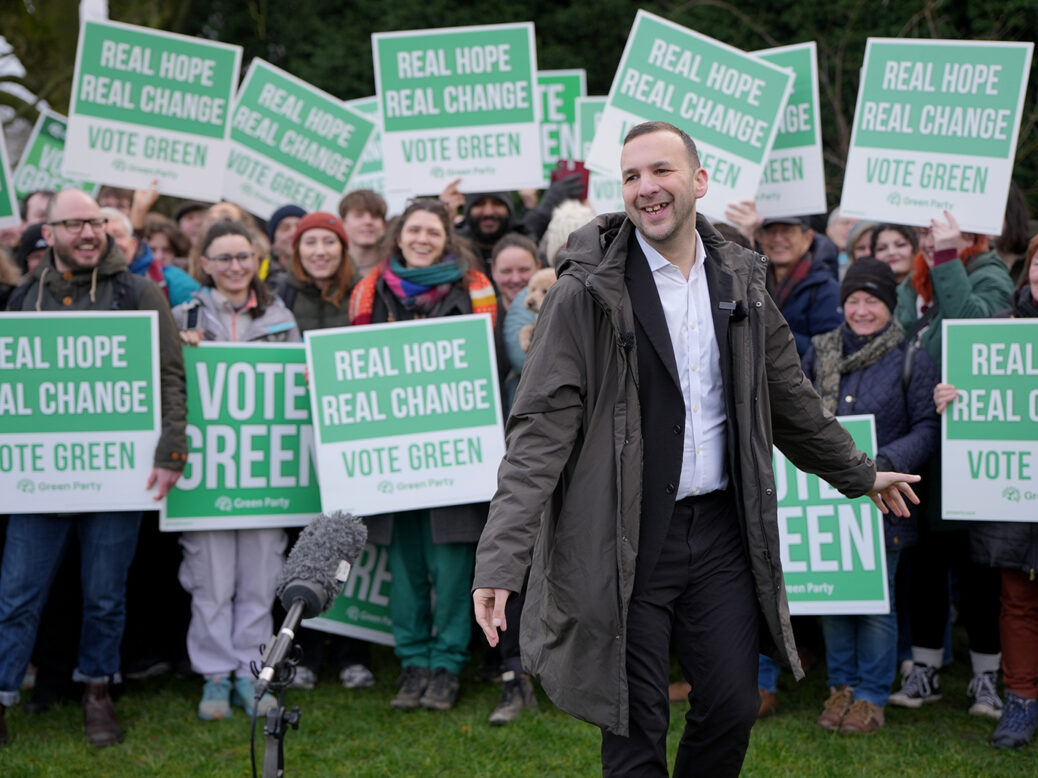
The elections in England, Scotland and Wales on 7 May will be Zack Polanski’s largest electoral test as leader of the Green Party to date. After the party swept the Gorton and Denton by-election on 26 February, winning with a 4,000 majority, something changed. The perception of voting Green being a “wasted vote” no longer holds. As a result, Polanski has set his sights on big wins in London, Wales and other pockets of England such as Newcastle in the northeast. The latest polling from More in Common, published two days ahead of the vote, put the Green Party in second place in half of all Labour-held London boroughs.
The New Statesman spoke to party insiders about the Green Party’s campaign strategy for this election, and how this differs from campaigns which have come before.
Who’s in charge?
The Green Party is a highly de-centralised party. Candidate selections are made by local branches (defections must also be voted on by members). The party’s head of elections is Chris Williams, the deputy chief executive, who leads on the Greens’ strategic planning and operational support via the staff team. Local parties are in charge of campaign planning in their areas, with support from the internal staff team. The Green Party Executive (GPEX) – the body which is responsible for the day-to-day running of the party – has governance oversight of all the party’s operational activities, including elections.
The Green Party Council, the 30-member body which deals with disciplinary matters, has also been involved in investigating and taking action against candidates found to have breached party rules. During this campaign, the council has been involved in actioning what the party describes as a “handful” of cases against members found to have made anti-Semitic comments online. The New Statesman understands that so far, two candidates who were arrested in Lambeth on suspicion of stirring up racial hatred online have now been suspended by the party.

Where are they targeting?
Traditionally, before the Greens’ recent surge, the party would have targeted a combination of rural areas, such as in Waveney Valley or North Herefordshire where Adrian Ramsay and Ellie Chowns are the MPs respectively, or non-metropolitan university towns such as Bristol or Brighton, which Carla Denyer and Sian Berry represent.
“There has obviously been a change in emphasis post-Zack,” one Green Party insider told me. “The policies haven’t changed, but the emphasis, style, communication and targeting have changed”. During this set of local elections, the party has instead aimed to focus on previous Labour strongholds, namely, London. The capital is prime territory for Polanski’s party; he plans to run for election to a seat in north London at the next general election.
Housing is a key issue among these voters. The capital’s treacherous rental market has been a defining issue in the Greens’ local election campaign this year. Launching the party’s manifesto in Lewisham on 9 April, Polanski pledged to prioritise affordable housebuilding, the introduction of rent controls, and the reform or replacement of the leasehold system. An internal campaign memo shared with the NS at the time encouraged activists to prioritise housing on the doorstep. The decision to launch the party’s local election campaign in Lewisham was made on the basis of the borough’s housing crisis.
Battling Labour and Reform?
According to one insider, canvassers have noticed something unexpected when out on the campaign trail: their ability to win over Reform voters. As Ben Walker has pointed out in the NS previously, the Greens seem to be able to take votes from Nigel Farage’s insurgent party.
According to campaign insiders, this is playing out for the Greens on the ground. Fed-up with the establishment, there is a sector of the electorate who feel so disillusioned with the two-party system that they plan to use their vote to inflict the most damage. A Green Party insider described some of these voters – who may largely have backed Reform – as “left-leaning economically and socially conservative”. They support public ownership of water and other utilities, eschew globalisation and back higher taxes on the wealthy.
And the internal campaign now suggests it has proof. When the party announced the ten-to-one ratio for all private and public sector organisations as part of their Fair Workers’ Charter, polling by YouGov showed that almost 60 per cent of Reform voters backed it. The party’s victory in Margate on 14 April, in which it took a seat on Kent County Council from Reform, has bolstered this analysis. “Outside of the metropolitan areas,” the insider said, “we’re finding a growing number of Reform voters are considering voting Green.”
The Polanski surge?
Polanski himself has been a crucial part of the campaign. Since the party’s launch in Lewisham in early April, he has travelled across the country to Scotland, Newcastle, Manchester, Hackney, Lambeth and elsewhere. A source close to him told me that this “is the kind of campaign that really works well for Zack. He gets his energy from going out there and meeting people. It really plays to his strengths.”
But he and his team are not complacent. “It feels really unpredictable,” a source close to him said. Throughout the campaign, the Green leader has tried to keep his focus on housing, the cost of living and affordability. He is also trying to back up friends standing for election, such as Zoe Garbett, his colleague on the London Assembly, who is running to become the Mayor of Hackney.
His team have also planned to take a social-first approach during the campaign. That means prioritising social media content, created by and for local parties, rather than committing excessive time to “intensive broadcast media”. As part of this, Polanski and his team have spoken with Maurice Katz, an American political strategist who worked on Zohran Mamdani’s 2025 campaign to become New York Mayor.
But the past week has been difficult for Polanski; he came under fire for re-tweeting a post which criticised the officers who responded to the stabbing of two Jewish men in Golders Green on 29 April. The force’s commissioner, Mark Rowley, wrote to Polanski, criticising him for the post and on 1 May, the Green Party leader apologised. Polanski’s comments around how the Greens have been dealing with accusations of anti-Semitism within the party have also been widely criticised for not going hard enough. Caroline Lucas, the former leader of the Green Party – and a party grandee – appeared to criticise Polanski’s handling of the situation in a post on X on 5 May. She said: “Statements that have now come to light from a handful of Green Party candidates are totally unacceptable & require immediate action. There’s no place for anti-semitism or any hate speech in the party.”
This confluence of events seems to have damaged Polanski’s standing. According to a poll by More in Common from Tuesday 5 May, Polanski’s approval ratings had dropped by 14 per cent. One Green Party insider said negative coverage of the party online – despite a positive reception on the doorstep – had dampened the mood in some circles.
Still, for the remaining days of campaigning, Polanski remains a prominent force. He will be in Cardiff on Wednesday for an eve of poll rally and plans to travel from Wales to London on election day, when he will tour the party’s targets in the capital.
What next?
This is certainly the biggest campaign the Green Party has run to date, and the small, volunteer-led party has faced difficulties. More than 4,500 Green candidates are running for the party on Thursday. Green sources have recognised there is a lot of work to be done to improve the party’s vetting processes, and there will now rightly be more scrutiny on the quality of candidates put forward by the party in future elections. Polanski is also likely to face even more questions as to how he is handling cases of anti-Semitism within the party.
Even so, the Greens expect to make some of their biggest ever gains in these polls, perhaps knocking Labour out of several London councils and forming their first ever group in the Welsh Senedd. If the polls are to be believed, and their campaign tactics have worked, then the Green Party could end up being the biggest disruptors of the night.
[Further reading: Could the Welsh Greens split from Zack Polanski’s party?]
Content from our partners

Related
Join the debate
Subscribe here to comment